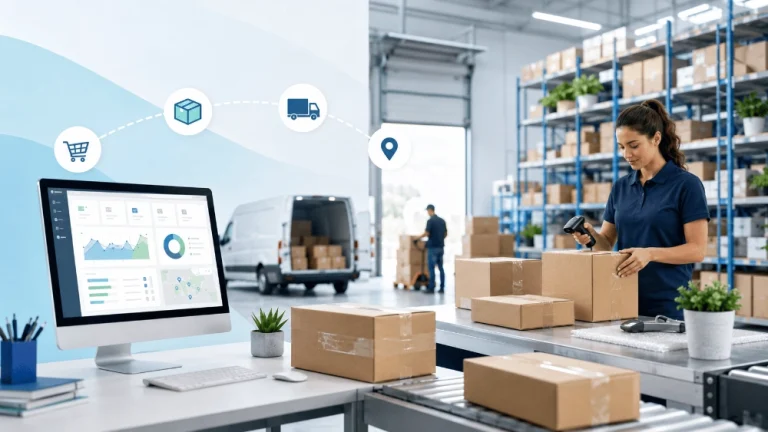
Choosing between shopify fulfillment options becomes more important as a store grows beyond its first orders. A simple setup may work at low volume, but higher sales introduce new questions: Should winning products be pre-stocked? Is supplier fulfillment still fast enough? Does the store need a 3PL, or would a mixed model work better?
There is no single model for every Shopify store. The practical choice depends on demand stability, SKU mix, shipping requirements, working capital, and how much control the merchant needs over packing and dispatch. Shopify supports merchant-managed fulfillment as well as external services, so stores can adjust the setup as operations change. Shopify’s fulfillment guidance explains the main platform options.
Which Shopify Fulfillment Options Are Available?
Most merchants use one of four shopify fulfillment models: self-fulfillment, dropshipping fulfillment, third-party fulfillment, or a hybrid structure.
Self-Fulfillment
With self-fulfillment, the merchant stores inventory and handles picking, packing, labeling, and carrier handoff. This gives direct control over stock and packaging.
It works best when the SKU range is limited and daily order volume remains manageable. As volume rises, warehouse tasks can start competing with marketing, merchandising, and customer service.
Dropshipping Fulfillment
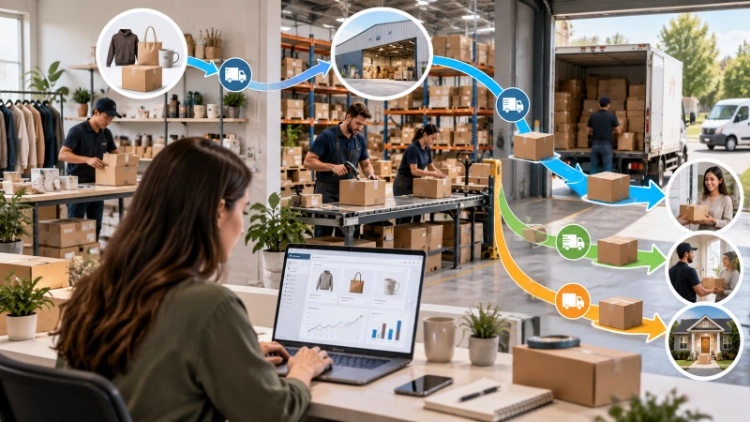
Dropshipping fulfillment keeps inventory commitments low because the merchant does not need to buy deep stock before demand is proven. After a customer orders, the supplier or fulfillment partner prepares the product and ships it onward.
The trade-off is greater dependence on supplier execution. Stock availability, product quality, processing time, tracking accuracy, and packaging consistency can all affect the customer experience.
Third-Party Fulfillment
A 3PL for Shopify holds pre-purchased inventory and handles receiving, put-away, pick and pack, labeling, dispatch, and tracking.
This model becomes more practical when demand is predictable enough to justify pre-stock. Before transferring inventory, merchants should review integration, returns handling, peak-season capacity, service levels, and error resolution. Shopify’s 3PL ecommerce guide provides a useful framework for evaluating these areas.
Hybrid Fulfillment
Hybrid fulfillment combines two or more methods. A store may keep strong sellers in warehouse stock while leaving new, seasonal, or lower-volume products under dropshipping fulfillment.
This structure gives proven SKUs a shorter route to dispatch without forcing every product into the same inventory strategy.
How Do Shopify Fulfillment Models Compare?
| Fator | Self-Fulfillment | Desembarque | 3PL | Hybrid |
| Inventory commitment | Medium to high | Low | Medium to high | Flexible |
| Merchant workload | High | Low to medium | Low | Medium |
| Packaging control | High | Varies | High if specified | Varies |
| Shipping control | High | Supplier-dependent | Higher with stocked goods | Mixed |
| Best fit | Small operation | Product testing | Stable growth | Mixed demand |
A self fulfillment vs 3pl decision usually appears when warehouse work begins to consume too much internal time. A dropshipping vs 3pl decision is more about inventory risk versus the speed and control that come with ready stock.
Order volume alone is not enough. A store selling a few predictable products may be ready for warehouse fulfillment earlier than a store that constantly tests and replaces products.
Which Fulfillment Model Fits Each Store Stage?
The most useful way to compare shopify fulfillment options is to match them to the current stage of the business.

Product Testing Stage
When demand is uncertain, large inventory commitments can limit flexibility. Shopify dropshipping fulfillment allows merchants to test products while keeping more cash available for advertising and additional product trials.
Supplier reliability, product quality, stock visibility, processing time, shipping methods, and tracking accuracy should be checked before traffic is scaled.
Early Growth Stage
Once several SKUs begin to sell repeatedly, the store can pre-stock a limited quantity of those products while continuing to dropship newer items.
This creates a practical first step toward hybrid fulfillment. Winning products can move faster without requiring the merchant to pre-purchase the whole catalog.
Stable Growth Stage
When the same products sell consistently, inventory becomes easier to plan. A 3PL for Shopify can take over receiving, stock control, picking, packing, and dispatch.
A defined warehouse process can also make handling more consistent without requiring the merchant to build an internal logistics team.
Scaling Across Products and Markets
Expansion into more countries or a broader catalog often creates different fulfillment needs inside the same store. Fast-moving items may justify warehouse stock, while long-tail products may remain better suited to supplier fulfillment.
A hybrid structure can separate products by demand level, destination, margin, size, or delivery requirement.
When Should a Shopify Store Outsource Fulfillment?
There is no universal order-volume threshold. The decision becomes clearer when daily operations show repeated friction.
Orders may leave later than planned because packing cannot keep up. Inventory counts may need frequent correction. Tracking may be uploaded manually after dispatch. Customer service may spend more time resolving delivery questions caused by warehouse delays or missing updates.
When these problems become routine, the current setup may be limiting growth. Shopify third party fulfillment is worth considering when an outside partner can remove those bottlenecks without reducing visibility over inventory and order status.
Before outsourcing, merchants should define packaging rules, quality checks, dispatch targets, stock alerts, and exception procedures.
Dropshipping or 3PL: Which Is Better for a Growing Shopify Store?
Dropshipping and 3PL fulfillment solve different problems.
Dropshipping protects flexibility and allows product testing without large inventory purchases. A 3PL becomes more attractive when several products have stable sales and ready stock can improve processing speed and handling consistency.
Many growing stores do not need one model for every SKU. New products can remain under dropshipping fulfillment while proven items move into pre-stock. This gradual transition reduces the risk of buying inventory too early.
How Do Cost, Speed, and Control Change Between Models?
Fulfillment cost should be assessed at the delivered-order level rather than by one warehouse fee. Receiving, storage, packaging, pick and pack, shipping, returns, replacement handling, and software charges can all affect the final cost.
O Shopify fulfillment cost breakdown covers the cost items merchants should include when comparing providers.
Speed also depends on more than carrier transit time. An order can be delayed because stock is unavailable, SKU data is wrong, the warehouse cutoff has passed, or tracking is returned late.
Control shifts with the model. Self-fulfillment keeps warehouse decisions inside the business. Dropshipping gives more responsibility to the supplier. A 3PL relies on agreed procedures, data accuracy, and service standards.
What Should a Shopify Order Fulfillment System Connect?
A shopify order fulfillment workflow should reduce repeated manual work between the store and the fulfillment side.
The system needs the correct SKU, quantity, customer address, shipping method, and stock source. Inventory should update when goods move, and tracking should return to the store after dispatch without another round of manual entry.
At higher volume, a small mapping error can affect many orders before it is noticed. ERP-based workflows can help centralize order status, stock, and fulfillment activity.
O auto fulfillment for Shopify guide explains how order sync and tracking sync can reduce these handoffs.
How Should You Choose a Shopify Fulfillment Partner?
Start with the parts of the process that are most expensive to get wrong.
If returns are a major concern, review quality inspection and packing procedures. If shipping speed matters, check how quickly stocked orders can be processed and what logistics channels are available. If branding matters, confirm how custom packaging is stored and applied.
Integration should also be tested against realistic order scenarios. Bundles, split shipments, address changes, and out-of-stock items can reveal gaps that a basic platform connection does not show.
Exception handling matters as much as normal order flow. Missing stock, damaged products, incorrect addresses, or delayed carrier scans still happen, so merchants should know who identifies the issue and what action follows.
Stores that also need sourcing may prefer a partner that connects procurement with fulfillment. The Shopify dropshipping agent guide covers the extra checks involved when sourcing, QC, packaging, and shipping are handled together.
LZDropshipping supports product sourcing, quality inspection, warehousing, order fulfillment, multiple logistics channels, ERP-based order management, automatic order synchronization, tracking, and custom packaging. These capabilities are relevant when a merchant wants one operational flow across sourcing and fulfillment.
A Practical Fulfillment Path for Growing Shopify Stores
A store does not need its final fulfillment model at launch.
Early product tests can stay under dropshipping. Proven SKUs can move into limited pre-stock when repeat sales justify inventory. Once a group of products sells predictably, warehouse or 3PL fulfillment can take over more routine work. If the catalog later includes products with very different demand levels or shipping needs, a hybrid structure can keep those groups on separate paths.
The most suitable shopify fulfillment options are the ones that fit current demand while leaving room for the next stage.
Conclusão
Shopify fulfillment models should change when the business changes. A store testing demand may need flexibility more than warehouse speed. A merchant with stable bestsellers may gain more from ready stock and repeatable handling. A larger catalog may need several fulfillment paths at the same time.
Review the setup when sales patterns, SKU mix, or delivery requirements shift. If the current process starts creating late tracking, stock corrections, or unnecessary manual work, the fulfillment structure may need to change.
For merchants comparing shopify fulfillment options, the most suitable model is the one that addresses the current bottleneck without creating a new operational constraint elsewhere.
FAQ
Q1. Which fulfillment option is suitable for a new Shopify store?
A1. A new store often benefits from keeping inventory commitments low until several products show repeat demand. Dropshipping can support that approach if supplier quality, processing time, and shipping reliability meet the store’s requirements.
Q2. When does moving from dropshipping to a 3PL make sense?
A2. The move becomes easier to justify when the same SKUs sell consistently and pre-stock can improve processing time, packaging consistency, or daily workload.
Q3. Can one Shopify store use more than one fulfillment model?
A3. Yes. Proven products can be stocked while new, seasonal, or lower-volume items remain under dropshipping fulfillment. The split can also follow destination, product size, or shipping requirements.