What is clear to the seller in the Seller Dashboard when making a TikTok Shop order can become an issue for fulfillment a few hours down the line. There can be issues with the product being ready to be shipped, there may be a label ready with no carrier scan, or the order remains in Awaiting Shipment even though the buyer wants something done about it. In 2026, the seller should understand that fulfillment will require a process, not just one click after the marketing part.
Why TikTok Shop Fulfillment Compliance Matters in 2026
TikTok Shop performance is shaped by more than product content and conversion rate. Late dispatch, cancellations caused by stock problems, and tracking that never receives a carrier scan can affect buyer trust and seller performance at the same time. A few delayed orders may be manageable. A repeated pattern can restrict the room a store has to run promotions or scale a winning SKU.
What Does Awaiting Shipment Mean on TikTok Shop?
When an Order Enters Awaiting Shipment
Waiting For Shipment implies that the buyer has ordered the item, but the seller hasn’t yet shipped it. Even if the payment has been received, the site does not consider it to have been shipped. The seller may be required to verify his/her stock and ship the parcel.
The important distinction is between an order being processed, a label being created, and a parcel being accepted into the logistics network. These are three different events. Treating them as the same event is one of the easiest ways to misread fulfillment performance.
Why Orders Stay in Awaiting Shipment
The common reasons could be the inventory not being synchronized, the supplier failing to confirm the purchase, the goods awaiting quality check, or the order not having reached the warehouse database. The package might have left the warehouse with the tracking number not yet appearing on the store order.
TikTok Shop Dispatch SLA: What Sellers Need to Control
Processing Time Is Not the Same as Dispatch Time
“Handling an order” could mean that a label was printed at the warehouse. Performance on TikTok Shop is normally focused on meeting the relevant requirement regarding dispatch, rather than completion of any internal step. The conservative approach is clear enough – the package must be packed, delivered to the appropriate carrier, and accompanied by proof of acceptance/scan.
Since TikTok Shop requirements vary by location in the US, the UK, Southeast Asia, and elsewhere, the relevant Seller Center requirement for your target store should be identified prior to writing any compliance article or setting any internal SLA. Do not copy the requirement from some other location; otherwise, you might be using the wrong number.
How Inventory and Warehouse Operations Affect SLA
Most late dispatch problems begin before the shipping label. A product may have sold faster than expected, a replacement batch may still be under inspection, or a warehouse cut-off may have passed before the order arrived. These details matter more during a live promotion, when a small stock mismatch can create dozens of delayed orders.
For proven SKUs, overseas fulfillment gives the seller a closer stock position and a repeatable dispatch routine. When inventory is available, same-day dispatch may be possible, depending on the order cut-off and warehouse workflow. The supplier should state the actual cut-off time.
What Happens When Dispatch Is Late
A late order can lead to cancellation, refund pressure, buyer complaints, and a weaker store performance record.
What Counts as Valid Tracking on TikTok Shop?
A tracking number alone does not equate to good tracking. The tracking number has to relate to the order, be the property of an actual carrier and have a series of logistics-related actions that can be verified. A package having a label yet without any acceptance scan is different from a package that has been introduced into the carrier network.
The following four items are important to verify: if there is a match between the order and tracking number, if the selected carrier is supported and legitimate, if the initial scan is posted after the handover of the package, and if subsequent scans occur along the way.

This is also why the warehouse handover matters. The seller should know which logistics channel was used, when the parcel was collected, and when the first scan is expected. QinTang can coordinate several routes, including YunExpress, Yanwen, Wanb, 4PX, and SF Express, so the shipping choice can follow destination, cost, and delivery requirements instead of being fixed to one channel.
How to Build a TikTok Shop-Compliant Fulfillment Workflow
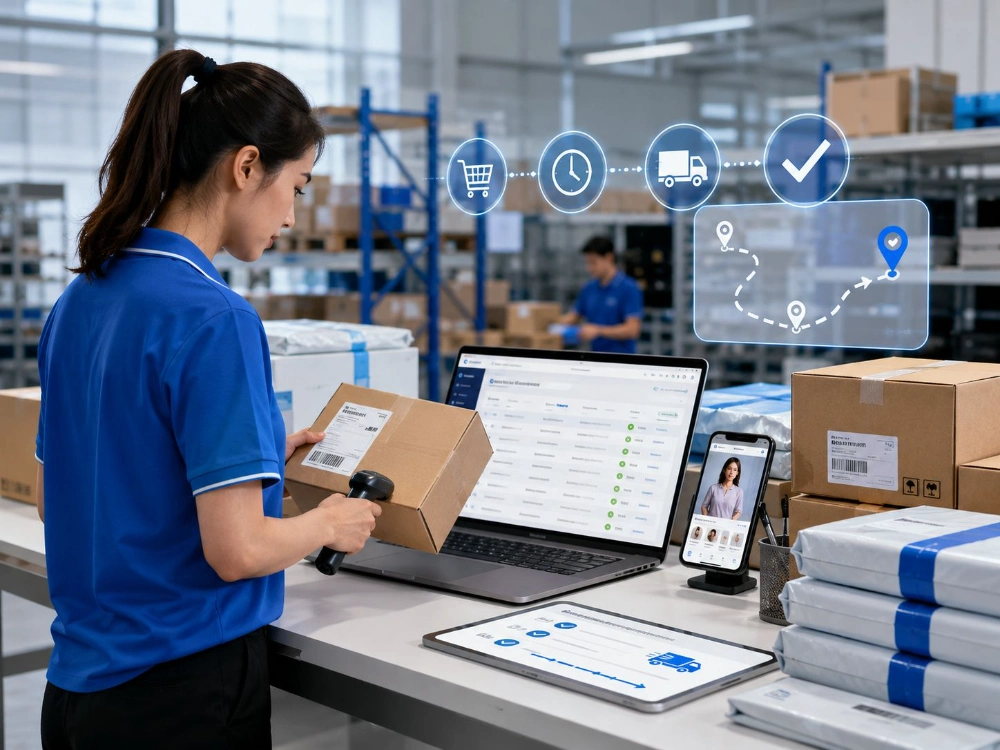
A workable flow has seven linked points: order synchronization, stock confirmation, purchasing when needed, picking and packing, quality inspection, carrier handover, and tracking updates. The seller should be able to identify the owner of each step. If everyone assumes somebody else is watching Awaiting Shipment, delayed orders become hard to recover.
A system that supports store authorization, automatic order fulfillment, Excel or CSV order import, freight calculation, and order tracking can reduce manual copying. QinTang’s ERP workflow is useful here because inventory, order handling, balance information, and tracking records can be checked in one place. The goal is not more software. It is fewer gaps between the store order and the real parcel.
What Sellers Should Check Before Choosing a Fulfillment Partner
Ask how quickly the supplier can source a replacement SKU, confirm a quotation, and report an inventory change. Ask for the warehouse cut-off time, the normal time between packing and carrier acceptance, and the process used when a product fails inspection. These answers are more useful than a general promise of reliable fulfillment.
A partner such as LZ Dropshipping should be judged by the whole chain: sourcing, stock management, quality checks, packing, delivery, and after-sales communication. A product sourcing workflow matters when a winning listing needs a variation quickly, while automatic fulfillment support matters when manual order forwarding starts to create delay.
The logistics side also needs evidence. Check whether tracking is uploaded after the actual handover, whether the system can show freight and movement records, and whether a customer-service contact can handle an exception. A one-click ordering process can reduce repeated data entry, but only if the SKU, address, quantity, and shipping method are mapped correctly.
Domestic Dropshipping or Overseas Fulfillment for TikTok Shop?
Domestic dropshipping can work for early product testing and unstable demand. It limits upfront stock and lets the seller test a product before moving inventory overseas.
When a small group of SKUs produces steady orders, overseas fulfillment is usually easier to control. Stock is positioned closer to customers, warehouse staff can repeat the same dispatch routine, and the seller has a clearer basis for replenishment. The move can be staged rather than permanent: keep uncertain products in a lighter model and place proven products in local or regional stock.
For multi-store sellers and brands, the main advantage is consistency. The same inventory logic, inspection standard, packaging instruction, and tracking process can be applied across more orders. That consistency is valuable when a TikTok Shop promotion creates a sudden jump in demand.
FAQ
Q1: Is a tracking number enough to meet TikTok Shop fulfillment requirements? A1: No. The number should match the order, belong to a real carrier, and show genuine acceptance or movement. A label without a carrier scan can still leave the order exposed.
Q2: Can overseas fulfillment reduce late dispatch risk? A2: It can reduce the distance and manual handling involved when proven products are stocked near the target market. It does not replace inventory planning or a clear warehouse cut-off.
Q3: Can LZ Dropshipping support TikTok Shop sourcing, fulfillment, and tracking? A3: Yes. Sellers can contact LZ Dropshipping to discuss product sourcing, quality inspection, warehousing, logistics channels, order fulfillment, and exception handling for a specific market.