
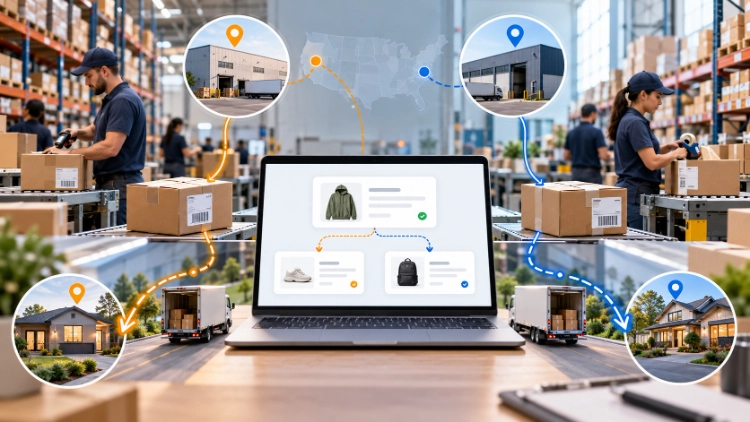
A customer orders a hoodie and phone case from one Shopify store, then receives two delivery notices. The items may come from different warehouses or leave at different times. Shopify split shipping can make separate shipments visible at checkout, but some splits can be avoided before an order reaches the warehouse.
Better stock placement, order routing, or selective consolidation may reduce unnecessary parcels. Checkout charges and actual fulfillment costs are separate questions: a customer might pay one shipping rate while the merchant purchases two labels.
Why Does Shopify Split One Order Into Multiple Shipments?
Common triggers include inventory at different locations, separate shipping profiles, preorders, subscriptions, and certain third-party fulfillment arrangements.
Consider a store selling a stocked travel mug and a custom-printed sweatshirt. The mug is ready today; the sweatshirt cannot be printed until artwork is approved. Holding both items for one dispatch delays the mug. Shipping them separately requires another parcel, but the available item reaches the customer sooner.
Warehouse A may have the mug while Warehouse B holds the sweatshirt. Shopify’s routing rules can assign the items to both locations when one cannot fulfill the entire order. A checkout shipment group is not necessarily the final parcel count, and a combined checkout charge does not physically combine inventory.
What Changes With Shopify Split Shipping in 2026?
Shopify is rolling out updated split-shipping checkout behavior alongside shipping options by market. Availability and the way shipping rates are charged depend on the store’s configuration. Once a store upgrades to shipping options by market, split shipping is activated automatically; the previous on/off setting no longer applies.
Eligible checkouts can display separate shipments and offer lower-cost or faster delivery choices. Customers may choose shipping methods for individual shipments, but cannot decide which products belong in each group.
The Shopify split shipping checkout rules also identify limitations involving certain draft orders, local delivery, and quantities of the same line item that cannot be fulfilled from one location. Merchants using fulfillment apps should test compatibility before relying on the checkout display.
From October 1, 2026, merchants became eligible to opt into shipping options by market. Within the same shipping option, eligible flat or order-amount rates can be combined so the highest matching rate applies. Different options, app-provided rates, and preorders may still produce added charges. Under the announced 2026 fulfillment changes, split shipping is scheduled to become the default for eligible checkouts on July 1, 2027.
Before changing rates, test carts drawn from real orders: two items stocked together, two locations, a preorder, and products assigned to different shipping profiles. Record what the customer sees and how many parcels the warehouse actually expects to dispatch.
When Should Orders Be Split or Combined?
One parcel is not always cheaper overall. Waiting for production or transferring stock can cost more than a second dispatch.
| Order situation | Usually better approach | Main consideration |
| Both items available at one warehouse | Pack together | Packaging and carrier limits |
| Two suppliers with quick inbound consolidation | Compare combined shipping | Inbound freight and handling |
| One item awaiting production | Consider separate dispatch | Promised delivery dates |
| Fragile and heavy items in one cart | Assess separate parcels | Damage and dimensional weight |
| Stock in distant fulfillment regions | Compare local dispatches | Transfers, duties, transit time |
Suppose two parcels cost $13.80 in postage, handling, and materials, while one combined parcel costs $8.50. The apparent saving is $5.30. If moving an item to the packing location adds $4.50, only $0.80 remains before allowing for any waiting time or damage risk. These figures illustrate the calculation; they are not carrier quotations.
A late delivery can outweigh a small saving on packaging and postage.
How Can Stores Reduce Unnecessary Split Shipments?
Put Frequently Paired Products in the Same Location
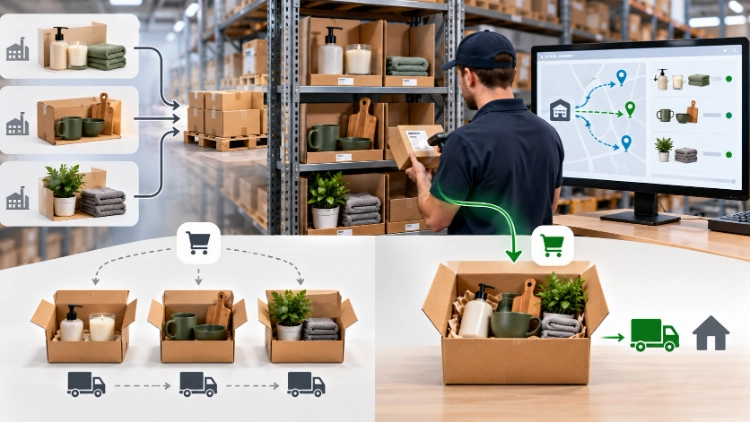
Review products that customers buy together, not only individual SKU sales. Stocking a popular phone case and matching charger at one warehouse may eliminate recurring splits. Compare the extra stock commitment with past parcel charges before duplicating inventory. A low-margin accessory may not justify placement at every location.
Check Location Priorities and Available Inventory
Shopify’s Minimize split fulfillments rule prioritizes locations that can fulfill the entire order. When none can, it favors arrangements requiring fewer shipments. It cannot overcome missing inventory, product-specific fulfillment restrictions, or other applicable routing conditions.
Check the locations eligible to fulfill online orders, stock quantities at the time of purchase, and the remaining routing rules before changing location priority. A delayed inventory feed can cause splits even when the routing configuration is otherwise sensible.
Consolidate Supplier Deliveries Selectively
Products from different suppliers can sometimes arrive at one warehouse for inspection and packing before onward shipment. That arrangement may suit bundles or repeat-selling items, but only if inbound timing and handling charges support it.
Confirm arrival dates, warehouse cutoffs, inspection steps, storage fees, and responsibility for missing goods. Direct dispatch may be preferable for an urgent order if consolidation would delay a ready item.
Keep Exceptional Orders Visible
Two stocked items may ship together while a customized item remains on hold. Address problems, damaged goods, and unavailable variants need a defined review process rather than an automatic release.
The choice also relates to broader Shopify fulfillment options, especially where stocked products and dropshipping orders share one storefront.
How Does Split Shipping Affect Costs and Tracking?
Extra parcels can mean additional packing materials, handling, and postage. Combining heavy and fragile items, however, may increase damage exposure or dimensional-weight charges. Compare the actual packed weight and dimensions, not just the number of labels.
The shipping amount collected at checkout is not the merchant’s fulfillment cost. Depending on the Shopify configuration, one rate may cover several shipment groups or applicable rates may be added. Reconcile those charges against carrier and warehouse invoices. Include receiving, storage, returns, and handling when reviewing Shopify fulfillment costs.
Tracking requires equally careful handling. One Shopify order may have separate fulfillment records and tracking numbers. Each number should identify the correct carrier and shipped items. Marking the whole order fulfilled after only one parcel leaves can mislead customers about what is still outstanding.
Customer updates should identify the contents of each shipment and distinguish a label created from a parcel actually scanned by the carrier. For stores handling frequent partial orders, auto fulfillment for Shopify should account for shipment-level tracking rather than relying on a single order status.
What Should a Fulfillment Partner Handle?
Split orders reveal gaps between purchasing, stock records, and warehouse execution. A merchant sourcing from several suppliers needs reliable variant matching, receiving checks, and a clear decision on whether items should wait for consolidation or ship separately.
LZ Dropshipping supports product sourcing, quality inspection, warehousing, order fulfillment, multiple shipping channels, and ERP-based order management. This allows merchants to discuss purchasing and dispatch within one service arrangement. Whether separate supplier deliveries can be combined for a particular order depends on warehouse availability, arrival dates, packing requirements, and agreed charges.
Test a two-item cart, a split-location order, a preorder, and an address exception. Ask who controls allocation and parcel release, when tracking is returned, and which charges apply. A useful shipment report identifies the order, items, warehouse, carrier, and tracking number for each parcel. If consolidation is offered, agree on a holding period and who approves delays.
What Should Stores Check Before Peak Season?
Before the 2026 holiday rush, run checkout tests with products from different locations, shipping profiles, preorders, and connected fulfillment apps. Record the customer-facing shipping charge alongside the anticipated number of warehouse parcels.
Review stock for popular product combinations, carrier cutoffs, packaging supplies, and notifications for partial deliveries. Compare the dispatch time of the first and last parcel in split orders. A long gap may indicate supplier lead time, not a carrier delay.
During promotions, monitor the split-shipment rate, parcels per order, additional cost per split, late second parcels, and customer support contacts. If the same product pairing repeatedly creates avoidable expense, moving inventory may be more effective than changing checkout rates.
Conclusion
Shopify split shipping is neither a checkout setting that solves every logistics problem nor a warehouse practice that must always be eliminated. Some orders require separate parcels because inventory is divided or an item is not ready. Others split because stock placement and routing no longer match customers’ buying patterns.
Review repeated product combinations, calculate the real cost of an extra shipment, and keep tracking accurate for every parcel. For stores managing purchases from several suppliers, discuss a suitable fulfillment arrangement with LZ Dropshipping. Share sample split orders, destination markets, inventory locations, and packing requirements so the proposed workflow can be assessed before committing to consolidation.
FAQs
Q: Why is my Shopify order split into two shipments?
A: Products may be held at different fulfillment locations, assigned to separate shipping profiles, or supplied as preorders or subscriptions. Check inventory availability and routing settings first. A third-party fulfillment app can also affect the shipment grouping shown at checkout.
Q: Can Shopify combine shipping costs when an order uses two warehouses?
A: Sometimes. Under shipping options by market, eligible flat or order-amount rates within the same option can be consolidated. Different options and certain app rates or preorders can still be added. The checkout charge does not determine the merchant’s actual parcel cost.
Q: How can a merchant reduce split shipments without delaying delivery?
A: Compare frequently purchased product pairs, confirm stock accuracy, and review routing rules. Consolidation is worthwhile only when inbound handling and waiting time are acceptable. Separate dispatch may better serve urgent items or products with longer production lead times.