En 2026, le dropshipping ne se limite plus à trouver un produit abordable, à mettre des images en ligne et à anticiper les ventes. Les ventes mondiales de commerce électronique devraient atteindre environ 6,88 billions de dollars en 2026., ce qui signifie plus d'acheteurs, plus de concurrence et des attentes plus élevées en matière de livraison, de qualité des produits et d'expérience de marque.
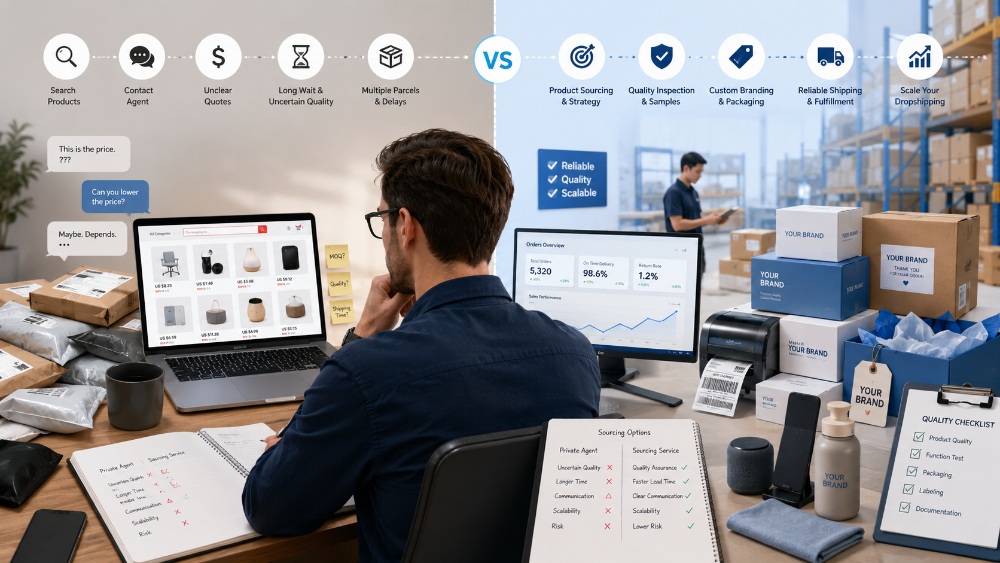
De nombreux commerçants débutent sur AliExpress car la plateforme est facile d'accès et pratique pour tester différents produits. Cependant, dès que le volume de commandes quotidiennes passe de 5 à 50, les points faibles deviennent plus difficiles à ignorer : réponses lentes, qualité inégale, suivi des commandes peu clair et faible marge de manœuvre pour la personnalisation. C'est alors que les vendeurs commencent à comparer un agent privé AliExpress à un service complet d'approvisionnement.
Le choix le plus judicieux dépend de votre stade de développement. Pour des tests préliminaires, AliExpress peut encore convenir. Pour une croissance plus rapide, un service d'approvisionnement offre généralement un meilleur contrôle sur les produits, l'emballage, la logistique et l'expérience client.
Agents privés AliExpress : utiles pour les tests, limités pour la mise à l’échelle
Le recours à un agent privé est souvent la première étape après l'approvisionnement via les plateformes publiques. Au lieu de commander chaque article individuellement parmi les annonces visibles sur AliExpress, le vendeur collabore avec une personne ou une petite équipe qui l'aide à trouver des produits, à obtenir des devis, à organiser l'expédition et à communiquer avec les fournisseurs. Cette solution peut fluidifier le processus, mais ne résout pas automatiquement tous les problèmes de mise à l'échelle.
Quand un agent privé vous aide
Un agent privé peut s'avérer utile lorsqu'un magasin a déjà testé un produit et recherche un approvisionnement plus direct. Cet agent peut aider à comparer les prix d'usine, à vérifier la disponibilité des produits et à organiser des livraisons plus rapides que celles proposées par les plateformes de vente en ligne. Pour les vendeurs qui diffusent des publicités sur TikTok, des publicités Metacritic ou qui misent sur l'influence, c'est crucial, car une livraison défaillante peut rapidement nuire aux commentaires, aux avis et au taux de remboursement.
Les agents privés peuvent également être utiles lorsque le vendeur ne parle pas chinois ou n'a pas le temps de contacter plusieurs fournisseurs. Au lieu de gérer dix conversations, le vendeur n'a qu'un seul interlocuteur, ce qui lui fait gagner du temps.
Pour les vendeurs à faible volume, ce modèle est souvent suffisant. Si une boutique traite entre 10 et 20 commandes par jour et n'a pas besoin d'emballages personnalisés, de contrôles qualité poussés ni d'un stock stable en entrepôt, le recours à un agent privé peut constituer une solution intermédiaire raisonnable.
Là où le modèle commence à se briser
Le problème survient lorsque l'activité du magasin prend de l'ampleur. Un agent indépendant peut dépendre d'un réseau de fournisseurs restreint. Si une usine est en rupture de stock, l'ensemble du flux de commandes est ralenti. Si la qualité des produits varie d'un lot à l'autre, le vendeur risque de ne s'en apercevoir qu'à l'apparition de réclamations clients.
Il existe également un problème de gestion. De nombreux agents travaillent encore par messagerie instantanée, tableurs et mises à jour manuelles. Cela peut s'avérer risqué lorsque le volume de commandes augmente. Une référence manquante, une couleur erronée ou un numéro de suivi tardif peuvent paraître mineurs, mais à grande échelle, ces erreurs entraînent des demandes de remboursement et une perte de confiance de la part des clients.
C’est pourquoi les vendeurs ne doivent pas juger un fournisseur uniquement sur son prix. La qualité des produits, la rapidité de livraison, le service client, les politiques logistiques et l’intégration à la plateforme sont autant d’éléments qui déterminent si une activité de dropshipping peut se développer sans en perdre le contrôle.
Quand AliExpress a encore du sens
AliExpress conserve un rôle pratique. La plateforme reste utile pour les études de marché préliminaires, les tests de produits et la vérification de la demande sur un créneau spécifique. Le guide du dropshipping de Shopify pour 2026 définit toujours le modèle selon lequel les fournisseurs ou les fabricants expédient directement aux clients, ce qui explique pourquoi les tests sur les places de marché restent courants pour les débutants.
L'essentiel est de savoir quand passer à autre chose. Si un produit enregistre des commandes régulières, présente un potentiel de fidélisation ou nécessite un meilleur emballage, le vendeur ne doit plus le considérer comme un produit test temporaire. À ce stade, la chaîne d'approvisionnement doit être prise plus au sérieux.
Service d'approvisionnement de produits : une solution mieux adaptée aux magasins prêts à se développer
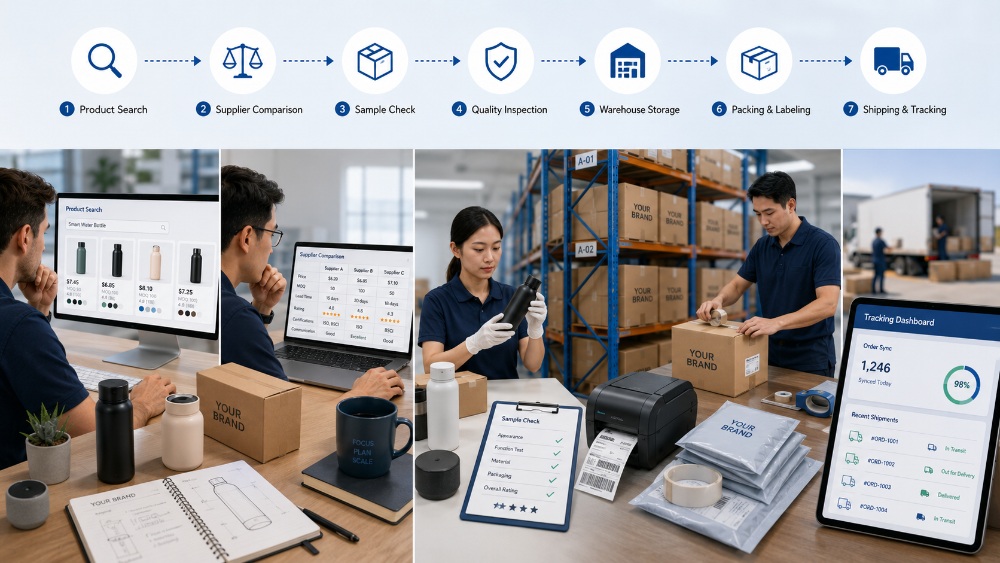
Un service de sourcing de produits ne se limite pas à la recherche d'articles. Un service performant coordonne le sourcing, la vérification des prix, la communication avec les fournisseurs, le contrôle qualité, l'emballage, l'entreposage, la gestion des commandes, l'expédition et le suivi. Pour les entreprises en pleine croissance, cette structure globale est essentielle car la croissance révèle les failles de leur infrastructure.
Contrôle renforcé des fournisseurs et des produits
Lorsque les vendeurs se fient uniquement aux annonces AliExpress, ils voient souvent le produit fini, mais pas la chaîne d'approvisionnement qui le sous-tend. Un service d'approvisionnement peut vérifier différentes usines, comparer les matériaux, examiner les options d'emballage et faciliter une planification des réapprovisionnements plus stable.
Ceci est particulièrement important pour les produits dont la taille, la couleur, la matière, les composants électroniques, le parfum, l'impression ou l'emballage fragile sont des facteurs importants. Une petite différence de matière ou de finition peut influencer l'avis de l'acheteur. Un partenaire d'approvisionnement contribue à réduire ce risque avant que les commandes n'arrivent chez le client.
LZ Dropshipping Son service d'approvisionnement se concentre sur la recherche de produits tendance, la mise en relation des vendeurs avec les fournisseurs et l'assistance logistique. Sa page de service met également en avant la mise en relation avec des usines certifiées, l'aide à l'établissement de devis, l'entreposage et la logistique dans le cadre du processus d'approvisionnement.
Contrôles de qualité renforcés avant l'expédition
Le commerce à grande échelle ne pardonne pas les défauts de contrôle qualité. Un produit d'apparence acceptable sur la photo peut présenter des rayures, des coutures lâches, une impression de mauvaise qualité, un emballage insuffisant ou des accessoires manquants. Si le vendeur ne s'en aperçoit qu'après réception du colis, le mal est déjà fait.
Un service d'approvisionnement peut effectuer un contrôle qualité avant que le produit ne quitte l'entrepôt. C'est l'une des raisons pour lesquelles de nombreuses boutiques en pleine croissance délaissent l'approvisionnement exclusivement via les places de marché. Elles souhaitent limiter les mauvaises surprises, les retours et les demandes d'assistance.
Pour les vendeurs B2B, il ne s'agit pas uniquement d'une question de coût. Les problèmes de qualité affectent les performances publicitaires, les avis clients, les réclamations par e-mail et le taux de fidélisation. Un fournisseur bon marché peut s'avérer coûteux si des problèmes de qualité récurrents entraînent des remboursements ou des remplacements.
Plus d'espace pour le dropshipping personnalisé
Une fois qu'un vendeur dispose d'un produit éprouvé, la question suivante n'est plus seulement « Puis-je l'expédier plus rapidement ? » mais « Les clients se souviendront-ils de ma boutique ? » C'est là que le dropshipping personnalisé prend toute sa valeur.
Les produits génériques sont faciles à copier. Les concurrents peuvent reprendre la même fiche produit, baisser le prix et adopter la même stratégie publicitaire. Un emballage personnalisé, des encarts, des étiquettes et des modifications mineures du produit rendent l'offre plus difficile à imiter. Ils donnent également à l'acheteur l'impression que le produit provient d'une véritable marque, et non d'un entrepôt quelconque.
de LZ Dropshipping service de personnalisation de marque Nous proposons des boîtes et des sacs d'emballage personnalisés, des étiquettes suspendues, des produits personnalisés, la sélection du fabricant, la confirmation de la conception, les mises à jour de la production, l'assurance qualité, l'emballage personnalisé et l'expédition internationale.
Quelle option les différentes boutiques de dropshipping devraient-elles choisir ?
Il n'existe pas de solution unique pour tous les vendeurs. Le choix optimal dépend du volume des commandes, du type de produit, de la trésorerie, de la stratégie de marque et du niveau de contrôle souhaité. Un vendeur débutant et une entreprise en pleine croissance réalisant un chiffre d'affaires à sept chiffres ne devraient pas utiliser le même modèle d'approvisionnement.
Choisissez un agent privé AliExpress si vous êtes encore en phase de test.
Le recours à un agent privé est judicieux lorsque la demande pour un produit n'est pas encore stable. À ce stade, le vendeur privilégie la rapidité et la flexibilité à une personnalisation poussée. L'objectif principal est de tester les publicités, les pages de destination, les prix et la réaction des acheteurs.
Cette solution peut fonctionner si :
- Vous vendez des produits de test en faible volume.
- Vous n'avez pas encore besoin d'emballages de marque.
- Vous comparez encore plusieurs niches.
- Votre taux de remboursement est faible.
- Vos clients acceptent des délais de livraison plus longs.
- Vous n'avez pas besoin d'un contrôle de production détaillé.
Pour ces vendeurs, se lancer trop tôt dans le conditionnement sur mesure ou la production en grande quantité peut engendrer des pressions inutiles. Un approvisionnement simple préserve la flexibilité de l'entreprise.
Choisissez un service d'approvisionnement si vous avez des produits gagnants.
Un service de sourcing de produits prend tout son sens lorsqu'il existe déjà une demande clairement établie. À ce stade, le principal risque pour le vendeur n'est plus de savoir si quelqu'un achètera ce produit, mais plutôt si l'infrastructure technique pourra soutenir la croissance sans nuire à l'expérience client.
Ce parcours convient aux vendeurs qui :
- Je reçois des commandes quotidiennes régulières.
- Besoin d'une exécution plus rapide et plus stable.
- Nous souhaitons de meilleurs contrôles produits avant l'expédition.
- Prévoyez de créer des produits de dropshipping personnalisés.
- Besoin d'emballage, d'encarts ou de détails de marque.
- Vendez via Shopify, TikTok Shop, WooCommerce ou plusieurs canaux.
- Je souhaite réduire le nombre de tâches manuelles liées aux commandes.
Le service d'exécution automatique des commandes de LZ Dropshipping comprend la synchronisation automatique des commandes, leur intégration à sa plateforme d'exécution, l'expédition internationale, le suivi et la prise en charge du traitement des commandes sur les principales plateformes de commerce électronique.
Utilisez les deux modèles pendant la transition
Certains vendeurs n'ont pas besoin de tout changer d'un coup. Une solution pratique consiste à conserver AliExpress ou des agents privés pour les premiers tests produits, puis à confier les produits ayant fait leurs preuves à un service d'approvisionnement.
Cette méthode hybride réduit les risques. Les nouveaux produits restent flexibles, tandis que les produits à succès bénéficient d'un meilleur contrôle des fournisseurs, d'un accompagnement en matière d'emballage et d'une planification logistique optimisée. Par exemple, un vendeur peut tester dix articles avec un agent privé, identifier les deux qui se vendent régulièrement, puis les faire produire en dropshipping personnalisé.
Ce changement favorise également le développement de la marque. Le vendeur peut créer des produits dropshipping personnalisés uniquement pour les articles ayant déjà fait leurs preuves sur le marché. Cela lui évite de dépenser de l'argent pour des produits qui risquent de ne pas se vendre.
Éléments à vérifier avant de choisir un partenaire d'approvisionnement
Avant de choisir entre un agent privé AliExpress et un service d'approvisionnement, les vendeurs doivent poser des questions opérationnelles, et pas seulement des questions de prix. Un devis bas est certes attractif, mais il n'a que peu d'intérêt si la livraison est lente, le suivi peu fiable ou si les lots de produits changent sans préavis.
Un partenaire d'approvisionnement sérieux devrait être en mesure d'expliquer :
- Comment les produits sont sélectionnés et comparés.
- Les fournisseurs sont-ils vérifiés avant toute collaboration ?
- Comment la qualité des produits est contrôlée.
- Que se passe-t-il lorsqu'un article est en rupture de stock ?
- Quelles sont les lignes maritimes disponibles ?
- Comment les numéros de suivi sont renvoyés.
- La synchronisation automatique des commandes est-elle possible ?
- Si l'emballage de marque est disponible.
- Comment le service client communique en cas de problème.
Pour les magasins en pleine expansion, la question la plus importante est simple : le partenaire peut-il soutenir une croissance reproductible ?
Une boutique qui traite 5 commandes par jour peut se contenter de tâches manuelles. Une boutique qui en traite 100 par jour a besoin de systèmes plus performants. Si le vendeur doit encore recopier les adresses, suivre les numéros de suivi et vérifier manuellement les stocks, la croissance devient source de stress plutôt que de rentabilité.
C’est là que LZ Dropshipping peut s’avérer utile aux vendeurs qui souhaitent centraliser l’approvisionnement, le contrôle qualité, l’emballage personnalisé et la gestion des commandes dans un seul et même processus. Les supports marketing de l’entreprise mettent également l’accent sur la rapidité de recherche et de devis des produits, le contrôle qualité, la diversification des canaux logistiques, un service client dédié et un système ERP pour la gestion des commandes et le suivi des comptes.
Les vendeurs qui envisagent de passer de produits génériques à des produits personnalisés en dropshipping peuvent contacter LZ Dropshipping pour discuter de l'approvisionnement en produits, des options d'emballage, du traitement des commandes et des itinéraires de livraison internationaux avant d'augmenter leurs dépenses publicitaires.
Conclusion
AliExpress et les agents privés restent utiles pour les tests initiaux, notamment lorsque les vendeurs ont besoin d'accéder rapidement à de nombreuses idées de produits. Cependant, développer une boutique dropshipping exige bien plus que des liens produits et des prix bas. Il faut un approvisionnement fiable, des contrôles produits, une maîtrise des expéditions, une gestion efficace des commandes et un espace dédié à la personnalisation de la marque.
Pour les vendeurs bénéficiant d'une demande établie, un service d'approvisionnement de produits représente souvent le choix le plus judicieux à long terme. Ce service permet au magasin de mieux maîtriser les normes de qualité, les détails d'emballage, les processus de livraison et l'expérience client. Lorsque l'objectif suivant consiste à passer d'une offre de produits aléatoires à une marque stable, contacter LZ Dropshipping Elle propose une méthode pratique. Ce contact permet d'examiner les options d'approvisionnement et contribue à définir une stratégie de croissance plus claire.