
“Awaiting fulfillment” represents an essential step in the online shopping order process, marking the shift from order confirmation to actual preparation of items for delivery. Delays in this phase frequently arise from stock discrepancies, poor storage coordination, or manual processes, which can slow down delivery speed, lower buyers’ satisfaction, and weaken confidence in the brand. Improvements at this stage come through automated systems, precise demand predictions, effective returns management, and distributed warehousing facilities. Connected solutions like auto fulfillment, global warehousing, and one-click ordering support quicker, more flexible operations and promote smoother movement from order placement to shipment.
Understanding the Role of “Awaiting Fulfillment” in E-commerce Operations
Defining “Awaiting Fulfillment” in the Order Lifecycle
From the perspective of online retail logistics, “awaiting fulfillment” describes a vital period in the order sequence. It is the point at which a customer order has been successfully placed and acknowledged by the system, and the process of preparing the items for shipment has commenced. “Awaiting Fulfillment” shows that warehouse staff have started picking and packing the listed items into suitable shipping containers. The status reflects active involvement by team members who locate products, verify them through scanning, and prepare them for secure packaging. However, this phase does not mean the package stands ready for immediate dispatch.
This stage usually comes before label creation and handover to carriers, and serves as an important link between order approval and outgoing transport. From a technical viewpoint, tracking this status allows companies to offer clear updates to buyers and also supports internal responsibility among processing teams.
Differentiating Between Common Fulfillment Statuses
Terms in e-commerce platforms sometimes seem to be similar, but have different meanings. For example, “awaiting fulfillment” and “pending fulfillment” carry nearly identical significance. Both indicate that the staff process, select, and pack the order into the required container. These terms are used interchangeably in different systems, though they point to the same situation — an order is prepared but not ready to ship.
In contrast, “awaiting shipment” represents a later stage, meaning the package stands fully prepared for transport, but the carrier has not collected it or received it. Therefore, “awaiting fulfillment” focuses on internal item handling, while “awaiting shipment” points to completed packing and waiting for external movement from the storage site.
Operational Impact of Extended Awaiting Fulfillment Periods
Key Reasons Orders Remain in This Status Too Long
This status should pass quickly, often within hours or a single working day, but the actual situation is not like what we expect. Delays frequently occur when staff cannot find items matching the order that may result from stock differences, incorrect labeling, or disorganized storage layouts. Goods might exist physically but remain hard to reach because of casual arrangement or the absence of livestock tracking.
Moreover, inadequate coordination between sales interfaces and storage activities may cause further lag. If an order system fails to update warehouse task lists promptly, delays will naturally accumulate. Improper inventory management can keep orders in “awaiting fulfillment” longer than planned.
Consequences for Customer Experience and Brand Reputation
Delays at this stage extend the overall order timeline — a figure monitored closely by transport experts. These weaknesses become noticeable to buyers, leading to dissatisfaction, negative feedback, or canceled purchases. Research showed that 72.7% of participants stated they would avoid future purchases from a site after a bad delivery appears. Continuous exposure to similar problems undermines the buyers’ attachment and increases support expenses from increased status questions.
Strategies to Optimize the Fulfillment Workflow
Streamlining Returns Management for Efficiency Gains
Returns management, though sometimes seen as an expense, can aid overall fulfillment improvement. Brands seeking greater control over manageable returns benefit from visible policy display on sites. Rapid re-entry of returned goods into sellable stock happens through organized reverse transport steps. This approach improves storage use and stock precision.
Reduced interference from returns maintains a steady primary fulfillment flow, which requires strong teamwork between return handlers and stock systems to collaborate closely.
Implementing Automation in Order Processing
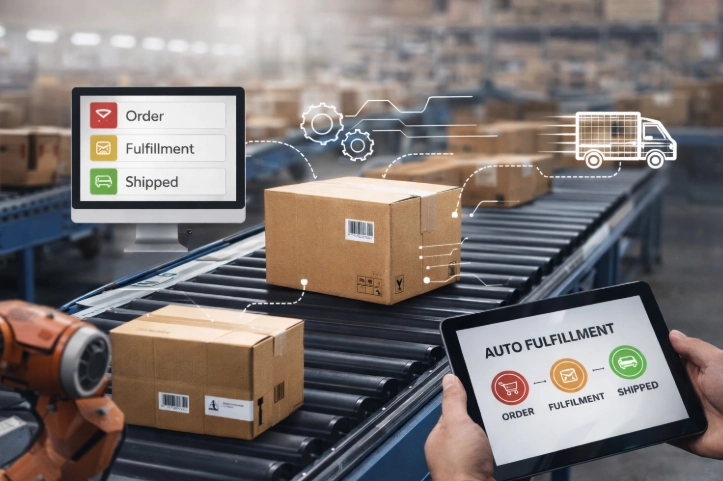
Automation stands among the strongest ways to shorten the time in “awaiting fulfillment” as it employs technology to handle orders rapidly without staff input. Automated setups can immediately create pick schedules, refresh stock records instantly, and produce packing directions. Such methods reduce dependence on workers while raising both pace and correctness.
Solutions like Auto Fulfillment from LZ Dropshipping demonstrate this approach. Auto Fulfillment handles regular activities automatically, which helps businesses expand without losing speed or accuracy. During busy sales periods or festive times, automation is essential for steady performance.
Leveraging Demand Forecasting to Improve Inventory Readiness
Accurate sales prediction is another major support for fulfillment performance. Forecasting provides deeper insight into promotion effects on stock conditions, movement of SKUs, and restock needs. With the help of predictive tools that estimate popular products at certain times, companies can place inventory in advance.
This readiness reduces blockages caused by delayed supplies or wrongly placed items — both of which can extend time spent in “awaiting fulfillment. Good prediction also assists workforce scheduling in storage areas, which can ensure that adequate personnel are available during high-activity windows.
Enhancing Fulfillment Through LZ Dropshipping Solutions
Utilizing Global Warehousing for Faster Order Turnaround
A prominent aspect of current fulfillment strategies is the distribution of stock across regions. Global Warehousing places inventory nearer to buyers, thus shortening transport distances. Sellers can dispatch regionally instead of from distant central locations due to the infrastructure of LZ Dropshipping distributing around the world.
This model noticeably shortens the period of awaiting fulfillment by enabling faster picking from local warehouses already stocked with popular SKUs.

Simplifying Order Management with One-Click Ordering
LZ Dropshipping further simplifies the workflows through its One-Click Ordering service. One-Click Ordering reduces friction between sales channels and backend logistics. By collapsing multi-step order entry into a single action that synchronizes across supply chain modules — procurement, picking, packing — this functionality accelerates time-to-fulfill. This integration is especially beneficial for multichannel retailers managing orders across platforms like Shopify or TikTok Shop.

Integrating Auto Fulfillment for Scalable Operations
Scalability becomes critical as e-commerce ventures expand their product offerings and customer base. LZ Dropshipping’s Auto Fulfillment module ensures reliable order flow regardless of volume spikes. It ensures consistent processing times even during high-volume periods like promotions or holidays.
This consistency is not merely operationally beneficial — it plays a direct role in enhancing customer satisfaction by ensuring timely delivery even when order volumes surge unexpectedly.
FAQs
Q: How long should an order typically remain in “awaiting fulfillment” status?
A: Ideally, this status should last only a few hours to one business day, depending on inventory readiness and warehouse efficiency.
Q: What can I do if my orders are frequently stuck in “awaiting fulfillment”?
A: Review your inventory management system, automate your workflows using services like Auto Fulfillment, and consider using regional warehousing solutions.
Q: Does LZ Dropshipping support automated transitions out of awaiting fulfillment?
A: Yes, LZ Dropshipping’s Auto Fulfillment service ensures orders move quickly through each stage by automating key processes from picking to packing and dispatching.