TikTok Shop est devenu l'un des canaux de vente les plus attractifs pour les vendeurs e-commerce internationaux. Cependant, son expansion engendre également un contexte opérationnel plus complexe. Un produit peut générer rapidement du trafic. Or, une infrastructure logistique défaillante risque de transformer ce trafic en retards de livraison, informations de suivi erronées, demandes de remboursement et performances médiocres du compte. En 2026, la logistique ne se limite plus à la gestion d'entrepôt. Elle fait partie intégrante des règles de la plateforme, de la fidélisation client et de la capacité de croissance de la boutique.
La politique de dropshipping de TikTok Shop (2026) impose aux vendeurs une charge de travail supplémentaire pour la rapidité d'expédition, la précision du suivi et la clarté des commandes. TikTok Shop exige des vendeurs qu'ils respectent les accords de niveau de service (SLA) relatifs à l'exécution des commandes, qu'ils fournissent des numéros de suivi valides et qu'ils maintiennent des indicateurs clés de performance pour des résultats constants. Pour les vendeurs pratiquant le dropshipping, cela signifie que le choix des fournisseurs, l'approvisionnement en produits, les contrôles qualité et la configuration de l'expédition doivent être intégrés dans un processus unique et non effectués manuellement en plusieurs étapes distinctes.
Pourquoi les règles de TikTok relatives à la gestion des commandes sont plus importantes pour les vendeurs en dropshipping
Les vendeurs sur TikTok Shop se concentrent souvent sur le contenu, les créateurs et les taux de conversion. C'est compréhensible, car la plateforme peut générer une demande très rapidement. Cependant, les faiblesses opérationnelles deviennent plus visibles lorsque le volume de commandes augmente. Une boutique capable de gérer dix commandes manuellement peut rencontrer des difficultés lorsqu'un produit commence à se vendre à grande échelle, surtout si la logistique repose sur des fournisseurs dispersés, la saisie manuelle des adresses et des mises à jour de suivi tardives.
Le SLA d'expédition n'est plus un détail administratif.
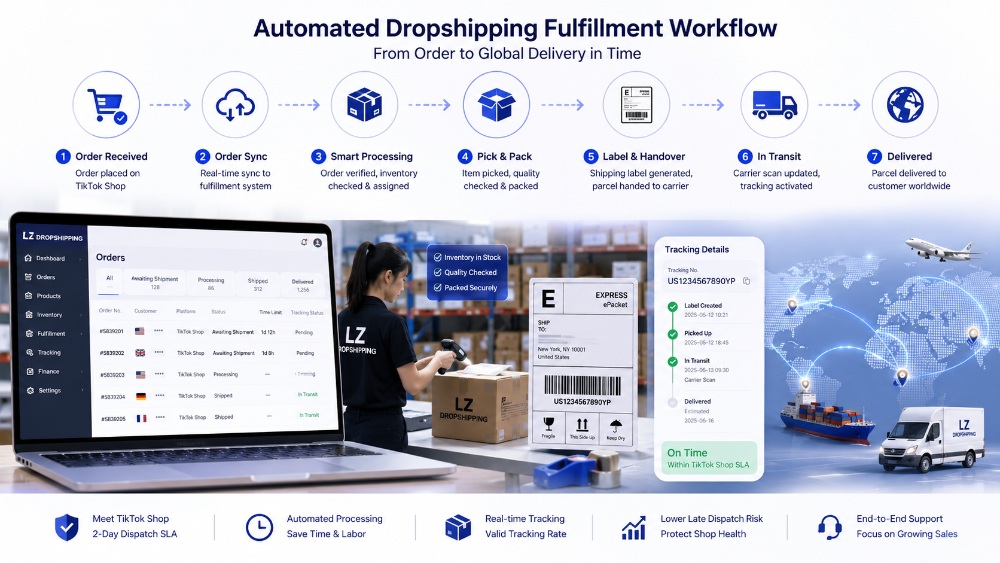
Les commandes régulières de la boutique TikTok doivent Passage de « En attente d'expédition » à « En transit » sous 2 jours ouvrables, Cela signifie que les scans de prise en charge par le transporteur sont importants, et pas seulement la préparation en entrepôt. Cette distinction est cruciale pour les vendeurs en dropshipping. Un fournisseur peut affirmer qu'un colis est prêt, mais la plateforme vérifie tout de même si la commande a bien reçu le scan requis par le transporteur dans les délais d'expédition.
Les retards d'expédition constituent donc un risque structurel. Ils ne sont pas uniquement dus à des retards d'entrepôt. Ils peuvent également provenir de confirmations de commande trop lentes, d'incertitudes quant aux stocks, d'une mauvaise coordination des emballages, d'étiquettes d'expédition erronées ou de problèmes de prise en charge par le transporteur. Lorsque ces problèmes se répètent, les indicateurs de performance du vendeur en matière de livraison se dégradent.
Pour les vendeurs présents sur TikTok Shop, Shopify, WooCommerce ou en boutique indépendante, les processus manuels augmentent le risque qu'un canal soit prioritaire tandis qu'un autre est négligé. C'est pourquoi la politique de dropshipping de TikTok Shop de 2026 doit être considérée comme un référentiel opérationnel, et non comme une simple règle de plateforme.
Les exigences en matière de livraison peuvent varier selon les marchés. Il est donc important que les vendeurs consultent systématiquement les règles les plus récentes dans leur Espace vendeur TikTok local. Cet article se concentre sur les aspects de la livraison les plus pertinents pour les vendeurs TikTok, notamment la gestion des délais d'expédition, le suivi précis des commandes, la coordination avec les fournisseurs et les processus de dropshipping.
Un suivi valide garantit la conformité et la confiance des acheteurs
La précision du suivi est un autre point critique. TikTok Shop exige Les vendeurs doivent maintenir un taux de suivi valide d'au moins 95 %., Des numéros de suivi invalides ou incorrects peuvent entraîner des mesures d'application telles que des déductions pour atteinte à la santé du compte, une visibilité réduite ou des restrictions sur les privilèges d'expédition du vendeur.
Pour les vendeurs ciblant le marché américain, les limitations du suivi transfrontalier doivent être examinées attentivement. Même après l'expédition physique d'un colis, des mises à jour de suivi incomplètes ou non prises en charge peuvent engendrer un risque de non-respect du taux de suivi valide.
Pour les acheteurs, le suivi est un gage de confiance essentiel. Pour les vendeurs sur la plateforme, c'est aussi la preuve que la chaîne logistique fonctionne correctement. Si les numéros de suivi sont téléchargés tardivement, s'ils ne correspondent pas aux transporteurs ou s'ils ne sont pas correctement scannés, l'expérience client se dégrade avant même la réception du colis.
C’est là que le dropshipping diffère de la logistique e-commerce traditionnelle. Le vendeur n’a peut-être pas de contact physique avec le produit, mais il supporte néanmoins les risques liés à la plateforme. Un processus professionnel doit donc intégrer la préparation du fournisseur, la confirmation de l’emballage, le choix du transporteur et le téléchargement du numéro de suivi dans une procédure unique et maîtrisée.
Pourquoi les expéditions sont-elles retardées dans les opérations de dropshipping ?
Un retard d'expédition est rarement dû à une erreur isolée. Il survient généralement lorsque plusieurs petites inefficacités s'accumulent. Un produit peut être rentable, mais le fournisseur peut tarder à confirmer sa disponibilité. Un entrepôt peut emballer correctement le colis, mais le transporteur peut ne pas le scanner à temps. Un membre de l'équipe peut passer la commande manuellement et saisir une référence, une adresse ou une option de livraison erronée. Ces problèmes s'aggravent avec l'augmentation du volume des commandes.
L'approvisionnement fragmenté en produits ralentit la préparation des commandes.
De nombreux vendeurs en dropshipping s'approvisionnent encore via une combinaison de places de marché, de fournisseurs informels, de tableurs et de messagerie instantanée. Cette méthode peut fonctionner lors des premiers tests, mais elle devient fragile dès que les ventes augmentent. Lorsqu'un produit devient populaire sur TikTok Shop, le vendeur a besoin de réponses rapides : l'article est-il disponible ? Son prix est-il stable ? Le fournisseur peut-il assurer des commandes régulières ? Le produit peut-il passer les contrôles qualité avant expédition ?
La lenteur de l'approvisionnement engendre un effet domino. Si la confirmation de produit est retardée, la passation de commande l'est également. Ce retard entraîne un retard dans la préparation en entrepôt. Si cette préparation commence tard, la prise en charge par le transporteur risque de ne pas respecter les délais de livraison convenus. Dans ce contexte, l'expédition tardive est souvent le symptôme ultime d'un processus d'approvisionnement inadapté à la rapidité de la plateforme.
Une préparation optimale commence avant même la réception de la commande. Les vendeurs ont besoin d'un approvisionnement fiable, d'une visibilité sur les stocks, d'une confirmation des prix et d'une communication fluide avec les fournisseurs. L'approvisionnement est particulièrement important pour les boutiques qui souhaitent tester rapidement des produits tout en minimisant les risques liés à des fournisseurs instables ou à une qualité inégale.
La gestion manuelle des commandes engendre des erreurs opérationnelles.
Le traitement manuel des commandes semble souvent simple au premier abord. Le vendeur saisit l'adresse du client, passe commande auprès d'un fournisseur, choisit un mode de livraison, attend le numéro de suivi et met à jour la plateforme. Le problème, c'est que chaque étape manuelle comporte un risque de retard ou d'erreur.
Pour les vendeurs de TikTok Shop, cela représente un risque, car un retard dans la prise en charge d'une commande peut se traduire par un problème mesurable sur la plateforme. Les erreurs d'adresse peuvent nécessiter une correction de commande. Les erreurs de référence (SKU) peuvent entraîner des réclamations pour article incorrect. L'absence de mises à jour de suivi peut engendrer des difficultés avec le service client. Le choix incohérent du transporteur peut accroître l'incertitude liée à la livraison.
L'automatisation du traitement des commandes atténue ces faiblesses en assurant une meilleure cohérence entre les données de commande, les étapes de traitement et le suivi des mises à jour. Elle ne dispense pas du jugement opérationnel, mais réduit les tâches manuelles répétitives qui entraînent souvent des retards d'expédition.
Un suivi insuffisant accroît la pression après-vente
L'indication « En attente de traitement » est plus qu'un simple statut de commande. Pour de nombreux vendeurs, c'est un signal d'alarme indiquant que le traitement des commandes ne suit pas le rythme des ventes. Si la commande reste trop longtemps à ce stade, le client risque de demander des nouvelles, le délai de traitement continue de s'écouler et le vendeur dispose de moins en moins de temps pour résoudre le problème.
Ce problème se complexifie avec le dropshipping international. Les vendeurs doivent coordonner la disponibilité des produits, l'emballage, le choix du transporteur, l'acceptation de la commande et le suivi en temps réel avec différents intervenants. Sans visibilité en temps réel, l'équipe risque de ne constater le problème qu'une fois la commande en retard.
Un processus de suivi des commandes transparent permet aux vendeurs d'identifier l'origine des retards. Il favorise également une meilleure communication avec les clients, ce qui peut réduire les demandes de remboursement et les messages répétés du type « Où est ma commande ? ».
Comment l'automatisation des commandes contribue à un flux de travail plus fiable pour les boutiques TikTok
Un système de dropshipping performant ne doit pas se contenter d'accélérer le traitement des commandes. Il doit aussi simplifier la vérification à chaque étape. Les vendeurs doivent pouvoir savoir si une commande a été reçue, si le produit est disponible, si les contrôles qualité sont terminés, si le colis a été préparé et si le suivi a été correctement mis à jour. C'est tout l'intérêt pratique du traitement automatisé des commandes pour les vendeurs de TikTok Shop.
La synchronisation des commandes et la commande en un clic réduisent les frictions de traitement.
La première amélioration opérationnelle concerne la synchronisation des commandes. Grâce à leur intégration dans un flux de travail centralisé, l'équipe n'a plus besoin de recopier les informations client entre les différents systèmes. Cela réduit les risques de commandes manquantes, de doublons, d'adresses incorrectes et de retards de traitement.
Réalisation automatique LZ favorise un processus de commande plus organisé en aidant les vendeurs à traiter et à expédier les commandes grâce à un système d'exécution automatisé, tandis que LZ propose également le suivi des commandes, une logistique simplifiée, des processus de contrôle qualité et des fournisseurs vérifiés comme éléments de service essentiels.
La commande en un clic est également utile aux vendeurs qui souhaitent conserver un contrôle humain sur le choix des produits ou la confirmation des commandes. Au lieu de concevoir dès le départ un système interne complexe, ils peuvent simplifier le processus d'achat et de livraison tout en gardant une visibilité sur les décisions clés.
L'objectif n'est pas seulement la rapidité, mais aussi la constance opérationnelle. Une boutique qui dépend d'une seule personne pour la gestion manuelle de chaque commande devient vulnérable lors des pics de trafic, des fêtes, des campagnes marketing et des tests produits à grande échelle.
Les points de contrôle qualité réduisent les risques de remboursement et de réclamation
L'expédition rapide n'a que peu d'intérêt si le produit reçu est erroné. Sur TikTok Shop, les clients évaluent l'expérience globale, et pas seulement la rapidité de la livraison. Un produit en mauvais état, une mauvaise référence, des accessoires manquants ou un emballage insuffisant peuvent entraîner un remboursement, un avis négatif ou une demande d'assistance.
Les contrôles qualité sont particulièrement importants pour les catégories où les attentes des acheteurs sont élevées, comme les produits de beauté, les accessoires de mode, les produits pour animaux, les articles de santé et les produits personnalisés. Avant d'intensifier leurs campagnes publicitaires ou de lancer des campagnes de créateurs, les vendeurs doivent vérifier que la version du produit, son emballage et son état général sont identiques.
LZ Dropshipping Ce service met en avant des processus de contrôle qualité rigoureux, des fournisseurs vérifiés, l'approvisionnement en produits, la personnalisation de la marque, l'exécution automatisée des commandes, le suivi des commandes et une logistique optimisée. Il s'avère ainsi pertinent pour les vendeurs souhaitant réduire l'incertitude opérationnelle sans transformer le parcours client en une procédure de vente complexe.
Mises à jour du routage et du suivi logistiques : assistance à la conformité
Un processus de traitement des commandes fiable implique également le choix du canal logistique approprié. Toutes les commandes ne doivent pas emprunter le même itinéraire. La destination, le type de produit, le budget, le délai de livraison souhaité et les exigences de la plateforme sont autant d'éléments qui influencent le choix du mode d'expédition optimal.
Pour les vendeurs de TikTok Shop, les choix logistiques doivent impérativement garantir un suivi fiable et des scans rapides par les transporteurs. Opter pour une solution économique, mais source de retards de suivi, peut engendrer des risques plus importants pour le compte client, des réclamations et des demandes de remboursement. À l'inverse, un itinéraire légèrement plus structuré peut s'avérer plus avantageux s'il améliore la régularité des expéditions et la visibilité des commandes.
L'automatisation du traitement des commandes permet aux vendeurs de s'affranchir des décisions logistiques réactives. Au lieu de choisir les options d'expédition au cas par cas sous la pression, les équipes peuvent définir des itinéraires privilégiés, suivre l'état des commandes et adapter les règles de traitement en fonction du volume des commandes.
Élaboration d'un modèle de traitement des commandes évolutif au-delà de la conformité à la plateforme
La conformité est la première raison d'améliorer la logistique, mais elle ne devrait pas être la seule. Un système plus performant permet également aux vendeurs de tester leurs produits plus rapidement, d'améliorer l'expérience client, de maîtriser leurs dépenses publicitaires et de bâtir une marque plus pérenne. TikTok Shop peut certes créer un sentiment d'urgence, mais cette même rigueur logistique profite aux boutiques indépendantes et aux autres plateformes de commerce électronique transfrontalières.
Relier l'approvisionnement en produits à la capacité de traitement
Un produit ne doit pas être choisi uniquement parce qu'il paraît attrayant dans une vidéo ou qu'il est proposé à un prix avantageux. Les vendeurs doivent également s'assurer de la fiabilité de l'approvisionnement, de la régularité des contrôles, de la conformité de l'emballage et du respect des délais d'expédition.
Avant de déployer une campagne TikTok à grande échelle, les vendeurs devraient se poser plusieurs questions opérationnelles :
- Le fournisseur peut-il assurer des commandes régulières sans ruptures de stock fréquentes ?
- Le produit peut-il être vérifié avant l'expédition ?
- Le mode de livraison permet-il un suivi valide ?
- Le colis peut-il être scanné par le transporteur dans le délai imparti ?
- L'équipe peut-elle gérer un volume de commandes plus élevé sans goulots d'étranglement manuels ?
Ces questions transforment l'approvisionnement en produits en une décision relative à la logistique. Un coût de produit inférieur peut s'avérer inutile s'il entraîne des retards d'expédition, des demandes de remboursement ou une charge de travail supplémentaire pour le service client.
Utilisez la marque sans ralentir le processus d'expédition
La personnalisation de la marque permet aux vendeurs en dropshipping de se démarquer des produits génériques. Emballages, notices, étiquettes et présentation des produits personnalisés contribuent à fidéliser la clientèle et à donner une image plus professionnelle à la boutique. Cependant, elle complexifie également les opérations.
Chaque élément personnalisé doit être coordonné avant l'expédition. Si l'emballage de marque est manquant, erroné, retardé ou appliqué de manière incohérente, le vendeur risque de perdre du temps et la confiance de ses clients. Pour les vendeurs de boutiques TikTok, le risque est particulièrement élevé, car un produit viral peut entraîner une augmentation soudaine des ventes.
Le branding doit donc être intégré à un modèle logistique adapté. Les emballages personnalisés et les éléments de marque sont plus efficaces lorsqu'ils sont liés à la communication avec les fournisseurs, aux contrôles qualité, aux normes d'emballage et à la planification des expéditions. Dans le cas contraire, le branding devient une source de retard supplémentaire.
Surveillez les indicateurs avant que les problèmes ne se transforment en pénalités.
Les vendeurs doivent analyser leurs indicateurs de performance avant que ceux-ci ne donnent lieu à des sanctions. Parmi les indicateurs importants figurent les retards d'expédition, le suivi valide, les annulations dues au vendeur, les commandes non expédiées, les motifs de remboursement, les réclamations relatives à la livraison et les demandes d'assistance client concernant le statut des expéditions.
Ces indicateurs révèlent les points de blocage du processus de traitement des commandes. Une augmentation des retards d'expédition peut être due à la disponibilité des stocks ou au délai de scan par le transporteur. Une hausse des réclamations liées au suivi peut indiquer un problème de qualité des itinéraires ou de fiabilité des données de suivi. Enfin, si les demandes de remboursement mentionnent une incompatibilité de produit, le problème peut provenir du contrôle qualité ou de la confirmation des références.
Pour les vendeurs qui se préparent à développer leurs commandes TikTok Shop, une prochaine étape pratique consiste à Analysez votre processus de traitement des commandes avec LZ et identifier les points de ralentissement des performances au niveau de l'approvisionnement, du contrôle qualité, du traitement des commandes ou de la coordination logistique.
Conclusion
La politique de dropshipping de TikTok Shop pour 2026 renforce l'importance d'une gestion rigoureuse des commandes pour tous les vendeurs qui utilisent le dropshipping comme modèle de croissance. Les retards d'expédition, les problèmes de suivi et le manque de visibilité des commandes ne sont pas de simples problèmes de gestion ; ils peuvent nuire à la confiance des clients, aux performances de la boutique et à la stabilité de la plateforme. Les vendeurs qui souhaitent une croissance durable ont besoin d'un flux de travail qui connecte l'approvisionnement, les contrôles qualité, la synchronisation des commandes, l'acheminement logistique et les mises à jour de suivi. L'automatisation des commandes contribue à créer cette structure en réduisant les interventions manuelles et en offrant aux équipes un meilleur contrôle des commandes urgentes. Pour les vendeurs TikTok Shop, la meilleure solution logistique n'est pas simplement la plus rapide. C'est celle qui reste précise, transparente et évolutive face à l'augmentation du volume de commandes.