E-commerce warehousing and order fulfillment differ from traditional models primarily in delivery targets, operational speed, and warehouse design. E-commerce fulfillment ships products directly to consumers (D2C), emphasizes rapid processing through automation, and utilizes warehouses designed for picking diverse single-item orders in real-time. In contrast, traditional order fulfillment typically sends bulk shipments to retail stores or distribution centers, operates on slower batch cycles, and stores fewer SKUs in bulk. The key practical distinctions are that e-commerce fulfillment integrates deeply with online sales platforms, handles a high volume of individual customer returns, and manages a wide variety of SKUs for immediate shipment. Businesses choose e-commerce fulfillment for direct online retail and traditional fulfillment for B2B bulk wholesale. Services like LZ Dropshipping enhance e-commerce operations through global warehousing, automated workflows, and integrated product sourcing.
Understanding the Scope of Order Fulfillment and E-commerce Warehousing
Defining Order Fulfillment in the Supply Chain
Order fulfillment is just getting stuff from your storage spot into your customer’s hands. It starts when new stock arrives at the warehouse. It ends when the buyer opens the box and says “yes, I’m keeping it.”
The main steps are simple: receive goods, put them away, take an order, pick the items, pack the box, ship it out, and deal with any returns. Some companies do all this themselves. Others pay a 3PL company to handle it. This system works for selling to shops (B2B) or straight to people (B2C). The goal stays the same – get the right thing to the right person fast and without mistakes.
What E-commerce Fulfillment Entails in Practice?
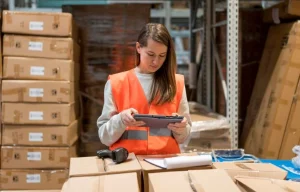
E-commerce fulfillment is order fulfillment made specially for online shops. Everything links straight to the website or app. When someone clicks “buy,” the order pops up in the warehouse right away. Workers grab the item, pack it, and send it off – often the same day.
Speed matters a lot here. Customers expect quick delivery, sometimes even two-hour windows. That is why e commerce warehousing and order fulfillment uses lots of computers and robots to stay fast and correct.
Functional Differences Between Traditional Order Fulfillment and E-commerce Fulfillment
Distinct Delivery Targets and Distribution Models
The most prominent operational divergence lies in the destination of the shipment. E-commerce order fulfillment ships products straight to the online shoppers who make a purchase. This D2C model contrasts with traditional order fulfillment, where shipments are generally routed to distribution centers or retail locations in bulk. The first difference between online fulfillment and traditional fulfillment is that the former ships products directly to customers while the latter sends the order to a distribution center for the customer to pick up.
Operational Speed and Automation Capabilities
Online shops need to move lightning fast. Most e commerce warehousing and order fulfillment runs on automation. Orders come in, computers tell workers what to pick, robots help carry things, and packages leave hours later.
Old-style warehouses work in big batches. They fill a truck once a week and send it to stores. Speed is not the main goal there.
Warehouse Design and Storage Utilization
Physical layout and storage practices also differ sharply. E-commerce warehouses function as hybrid storage-distribution centers geared toward high-frequency picking of single or small quantities of items. With E-commerce, fulfillment warehouses are the distribution centers. In contrast, traditional warehouses stock bulk products that are replenished at regular intervals to retail locations. This implies different shelving systems, picking technologies, and operational workflows.
SKU Management and Product Diversity Handling
Online stores often sell thousands of different items. Every color, every size gets its own code (SKU). Workers need to find any one fast.
Regular warehouses usually keep far fewer kinds of products. Fewer SKUs make life simpler when you ship in bulk.
Return Management and Customer Service Integration
Online shoppers return things a lot – clothes that don’t fit, gifts they don’t like. E-commerce warehouses have big return areas and connect right to the website so customers get money back quickly.
Traditional systems hardly see returns because stores handle them instead.
Matching Fulfillment Models to Business Scenarios
When to Choose E-commerce Fulfillment Solutions?
Pick e commerce warehousing and order fulfillment if you sell online and send lots of small packages every day. It works great for shops on Shopify, Amazon, or your own website. Fast shipping and happy customers are the main goals here.
When Traditional Order Fulfillment is More Suitable?
Stick with the old way if you sell big loads to shops, restaurants, or other companies. Pallets and containers are cheaper when you move tons at once and don’t need same-day speed.
Leveraging LZ Dropshipping Services for Efficient E-commerce Operations
Streamlining Global Logistics with Global Warehousing by LZ Dropshipping
LZ Dropshipping puts warehouses in many countries close to buyers. Your goods sit near the customer, so packages arrive in just a few days instead of weeks. Shipping gets cheaper and faster.
Automating the Fulfillment Workflow with Auto Fulfillment Services
With LZ Dropshipping Auto Fulfillment, everything happens by itself. An order comes in from your shop, the system sees it, picks the item, packs it, prints the label, and hands it to the courier – no person has to click anything. Fewer mistakes, happier customers.
Enhancing Product Availability Through Product Sourcing Solutions
LZ Dropshipping also helps you find hot products from good suppliers. You don’t have to buy thousands upfront. They store the items and ship only when someone buys from you. Perfect for testing new ideas without risking lots of money.
Besides, LZ Dropshipping also provides other kinds of services, such as global warehousing, custom branding and so on, so you can contact LZ Dropshipping if you have wish to cooperate.
FAQs
Q: How does e-commerce warehousing differ from traditional warehousing?
E-commerce places focus on storing single items, grabbing one piece fast, sending tiny packages, and linking to shopping websites. Traditional places store big pallets and ship whole truckloads to stores.
Q: Can I use LZ Dropshipping’s Auto Fulfillment even if I sell on multiple platforms?
Yes! It connects to almost every shop platform, so all your orders from different sites come to one place and go out fast.
Q: What advantages does Global Warehousing offer over local storage?
LZ Dropshipping’s Global Warehousing keeps your stuff close to buyers all over the world. Packages arrive quicker, shipping costs drop, and customers smile more.